


.svg)
The Ultimate Guide to Multi-Deck Mixing: How DJs Master Four Deck Mixes

Wow your fans with a new dimension in DJ performance. While standard two-deck mixing forms the foundation of most DJ sets, the jump to three, four or more decks represents a more challenging and artful live DJ performance. This is where DJing transitions from simple A to B mixes to sculpting complex soundscapes and compositions, mastering advanced EQ control and elevating the listeners experience.
This comprehensive guide covers everything from the fundamental concepts to advanced technical troubleshooting, helping you navigate the complexities and unlock the immense creative potential of multi-deck mixing. Save this article If you want to build unique sonic moments that only exist once and graduate your DJ mixes to the realm of artistry.
Part 1: The Multi-Deck Concept - From DJ to Conductor
Why Mix With More Than Two Decks? Granted, it's not for everyone. So, who should mix with more than two decks and why?
Most DJs don't need to attempt mixing with multiple decks, and should probably avoid it in most situations. It boils down to what type of DJ you are. The vast majority of DJs around the world are those that play popular songs for audiences in local pubs, small clubs, discos, parties and weddings. The job of those DJs is to create the vibe by playing the music the crowd know and love. It's more about song selection than creating an interesting sound scape. Those DJs can still benefit from using multiple decks, and commonly use a third deck for acapella mixing and for launching simple samples. For the purpose of this guide, we are going to focus instead of DJs who want to create interesting spontaneous soundscapes, mostly with instrumental music.
Fundamentally this is because the main issue with mixing multiple tracks at once is overloading the listener with a chaotic ensemble of sounds. Popular music is often filled to the max with vocals and instrumentation. This leaves no room for other elements.
The type of music that does leave room for additional sounds are more like instrumental raw ingredients. Think of genres like techno, deep house, progressive trance, ambient, or certain strains of minimal, drum and bass, and dub.
With these types of genre, tracks are often deliberately arranged with space and repetition in mind. They are DJ-friendly in the sense that they are designed to layer together within a larger DJ mix. They are constructed with evolving loops, hypnotic grooves, and layered textures rather than dense song structures. With these genres you can become the conductor and add your own counter-melodies, percussive accents, and atmospheric flourishes. In this context, the additional decks become tools to add more layers and the mixer becomes the hub where you highlight the frequencies you want to hear and deduct the ones that you want to hide. Thus, allowing you to build, deconstruct, and recompose on the fly.
The Core Philosophy: Orchestration, Not Stacking
The goal isn't to play as many tracks as possible, it's to create a soundscape that has intentional elements, effects and layers arranged to create an evolving journey. Something that captivates the listener rather than confuses them. It's easy to overdo it when mixing with multiple decks, so the primary role of the artist is to weave them together in a way that brings a benefit, rather than reduces the existing impact of the tracks.
Part 2: Foundational Techniques of Multi-Deck Mixing
The first steps in exploring multi-deck mixing are to gather and curate your music collection and then prepare your music. Once you've done that, you should choose your DJ setup and start experimenting with different combinations. You'll need to find the compositions that work and combine them to build a larger set.
Step 1: Curate Your Collection
Decide on your genre or style and then begin collecting suitable tracks and samples. Remember, you'll need to find instrumental elements that are not overly complex, they will need to layer with many other sounds. Avoid tracks that are already full with instrumentation and vocals.
Divide your collection into three parts, full tracks, samples, loops & stems.
There are many sources to find digital music online, including the main sources, Beatport.com and our favourite ethical source, Bandcamp.com. Click here for our own releases on LSA Records. Some of these music platforms also allow you to download samples, acapella, stems and more. One of the biggest most popular sites to download paid royalty-free samples is Splice. An interesting free source of sampled sounds is Freesound.org.
Don't forget, you can learn how to create your own tracks, stems and samples using a DAW (Digital Audio Workstation), such as Ableton or Logic Pro at our academy or online. Click here for our music production courses.
Make sure to manage the quality of your tracks and sounds. Click here to learn about the different bitrates needed for professional multi-deck mixing and how to check the quality of your files.
Step 2: Prepare Your Playlists
The next step is to use a pro-level DJ software program such as Pioneer DJ's Rekordbox, Serato or Traktor Pro to prepare your playlists. Within your program, carefully decide on a filing system and have playlists organised by file types including, tracks, stems, acapellas and samples. Within those folders you can organise the samples by instrumental type, such as drums, bass, melody, vocal, effects.
There is no right or wrong way to organise your music library so find a system that works for you.
Once you have the sounds within your playlists you need to check the beatgrids of all your tracks and add any cues, hot cues or loop markers you want to use. Click here to learn more about beatgridding with Rekordbox. You can also join our Rekordbox Masterclass or book a DJ course at DJ Gym, LSA or online to learn this skill.
Step 3: Choose Your DJ Setup
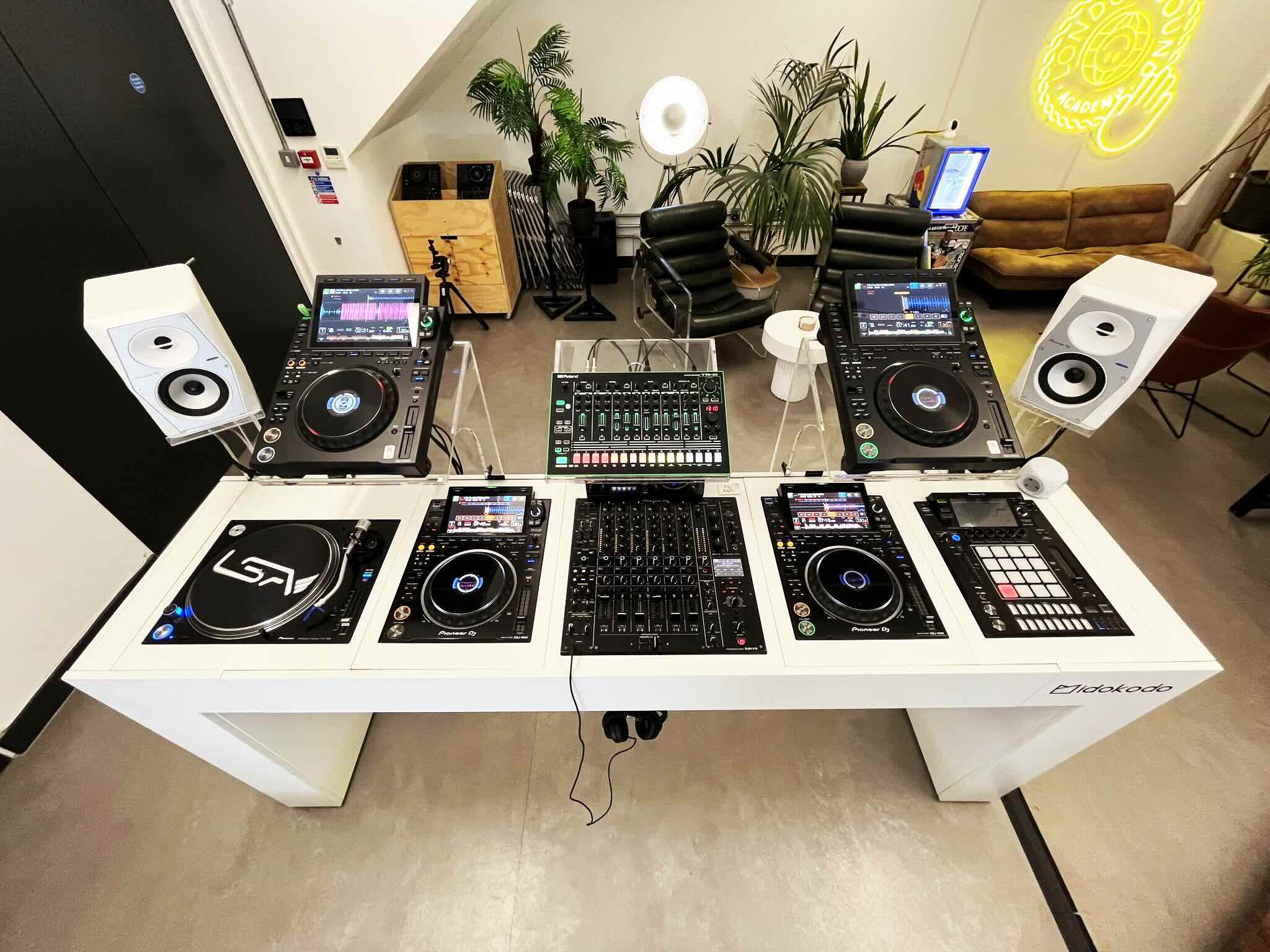
There are many ways of mixing four track decks at once. The main way for professional DJs is to have a multi-CDJ setup, such as having three or four CDJs plugged into a mixer. However, some DJs will not have access to such an expensive setup and will instead opt for a four-channel DJ controller, such as the Pioneer XDJ AZ. Some DJs will also use hybrid setups, like having a DJ controller with some turntables or even use Ableton Live.
make sure that your DJ mixer has ample effects and creative tools to help you gel the elements together. Post-fader effects are really important in multi-deck mixing so opt for an advanced DJ controller or mixer, such as the Pioneer DJ DJM V10.
What will be your multi-deck setup?

Step 4: Experiment With Technique
There are many ways to mix with multiple decks but following this structure will help you get started.
Main Deck 1: Carries the primary rhythm section (kick, bass, groove)
Main Deck 2: Ready with the next primary track
Harmonic Deck: Provides chord progressions, pads, melodies by means of stems and samples
Tool Deck: Add percussion loops, vocal acapellas, atmospheric elements and one-shot samples
Now you're ready to mix you should take your time to experiment with different combinations of your tracks, stems, acapellas and samples. Write down what works or create playlists in the order of the mixes. Experiment with different combinations and consider the overall flow of the set. Here are some themes to explore:
Theme & Relevance: Do you have a concept of what kind of story your mix is trying to tell? Perhaps you can group elements together into a theme and apply effects and transitions that are relevant to the soundscape you're building.
Progression & Musicality: Can you build complex progressions within the groove and melody that don't sound confusing to the listener?
Energy Control: Can you layer sounds together in a way to allows the energy to rise and fall creating your own structure?
Texture & Effects: Can you use effects to blur the lines between your samples, weaving them together into a rich tapestry of sound?
Signature Sound: Can you develop unique transitions and textures that define your style?
Step 5: Record & Assess
Part of developing your multi-deck DJ skills is to record your sets and experiments both in audio and video so that you can analyse their effectiveness. This process will help you identify what works and what doesn't so you can further refine your techniques. Find your best routines and see if you can use them to inspire further experiments until you have something that truly stands out. Multi-deck mixing is not something you can rush, take time to reflect and develop your craft. Review your efforts again key benchmarks, such as does the laying add to the music or detract from it, does it sound messy, does it fit the theme, etc.
Step 6: Practice & Refine
Practice, practice, practice! To master multi-deck mixing you need to rehearse as much as possible. This will allow you to learn your equipment inside out, refine your mixing skills, layering skills, and creative use of effects. It also takes a long time to try the multiple possible combinations of your chosen sounds. Enjoy the process and work toward refining your mix.
Where to Learn Multi-Deck Mixing
Granted, mixing with multiple decks is a highly advanced DJ skill. There are many important aspects to mixing with two decks, let alone three of four! If you want to truly master the multi-deck mix it's wise to seek professional tuition. At DJ Gym and over at our partners' London Sound Academy, we offer Europes most advanced DJ courses. Students start their journey by conquering two-deck mixing with our Beginner, Intermediate and Advanced DJ Courses. Then, only when they are ready they can take the Elite DJ Course challenge.
The Elite DJ Course is for advanced DJs who want to learn multi-deck mixing using the latest club-standard DJ tech, including advanced effects units such as the Pioneer DJ RMX100, samplers including the DJS 1000, drum machines including the Roland TR8 and turntables. It's the most advanced DJ course available in Europe taught by industry experts and some of the most creative people you'll ever meet!

Part 3: Advanced Mixing Considerations
Once you've established the bones of your multi-deck mix routine you'll want to dig a little deeper into the technicalities. Layering multiple sounds does throw up several issues that require specific solutions.
Phase Cancellation: What It Is & Why It Matters More With Multiple Decks
When similar low-frequency waveforms (especially kicks and basslines) align out-of-phase, they cancel each other out, creating weak, hollow or dull kick or bass. With 3+ decks, this risk multiplies, robbing your mix of the thumping and pumping energy that the bass end of the spectrum provides.
Phase Cancellation Solutions
Filters and EQ: Use a filter or EQ (ISO setting is best) and remove the low frequencies on other sound sources, cleaning up space for your kick and bass. For example, if applying reverb on the DJMV10 you can remove the LOW frequency on the Beat FX. Or, if you have a third deck element for the melody, try removing the bass by turning down the low EQ on that channel.
Transient Sculpting: Use volume envelopes or transient shaper effects (if available) to shorten kick drum decays, reducing overlap.
Frequency Slotting: Assign specific frequency ranges to each deck, easier with a four-EQ mixer, such as the DJM V10.
The Mono Compliance Test: Always check your layered mixes in mono. If the power disappears, you have phase issues.
Managing Frequencies for 3+ Channels
Visualise your mix as a pyramid where only one element dominates each frequency tier at any moment:
Main Deck 1: Main groove decks with sub bass, bass and low mids (minimise high frequencies here)
Main Deck 2: Next groove deck with low mids until the low-end is swapped or balanced with Main Deck 1
Harmonic Deck: Mostly mid and high frequencies but cut anything unnecessary for clarity
Tool Deck: Mostly upper mids and high frequencies here along with mid-based elements which can be added only when there is space in the mix
Conclusion: Musical Architecture
Multi-deck is about building a tapestry of sound by weaving together smaller elements in an orchestrated fashion. You can spontaneously build world of sounds that inspire emotion and evoke memory, transforming any moment into a cinematic journey. As with any architecture, it starts with a plan, a blueprint of how you're going to build something that won't crumble under its own weight. A good architect knows that the most breathtaking structures are not defined by rigid adherence to the plan, but by the inspired improvisations made within a solid framework. You have to bridge the gap between spontaneity and discipline.
Practice multi-deck mixing like you would practice a new language. Dedicate great time and keep drilling down into the best techniques you uncover. Expand your musical vocabulary by breaking down your favourite music into it's building blocks and then reconstruct them again in myriad forms.
We would love to hear your multi-deck mixes. Please send us links to your videos or recordings. Follow our blog for more useful DJ tips and guides.


